

The Ultimate Deep Dive Into justin bieber tattoos
Let us sit down and talk about justin bieber tattoos, because honestly, the man’s canvas is basically an ongoing art exhibit that we all cannot stop watching. I am writing to you from a cozy little cafe right here in the heart of Kyiv, sipping a half-sweetened flat white while watching the snow drift past the golden domes outside. Looking out at the street style here in Ukraine, it is wild to see how much of a global footprint pop culture leaves. Half the local youth currently walking past my window have sleeve tattoos that draw direct, heavy inspiration from Bieber’s exact aesthetic. Getting ink used to be a fringe, rebellious thing. Now, it is a globally understood language.
His body art tells a complete, raw story of faith, immense public struggle, romantic love, and personal redemption. I am going to walk you through his entire aesthetic journey, step by step, so you understand exactly what each piece represents and how his specific style evolved over the years. His tattoos are basically a public diary, completely exposed to the world, yet full of deeply personal secrets. Now that we are navigating through 2026, looking back at his ink history gives us a wild timeline of pop culture itself. We have watched him grow up, make mistakes, find his grounding, and document every single era directly onto his skin.
Read also: Ultimate Guide to Harry Styles Tattoos; Answered: How Old Is Mason Disick Right Now?.
So, what makes his ink so universally fascinating? It is the sheer dedication to the aesthetic. You see, getting a tattoo is not just about slapping some random ink on your skin; it is about permanently cementing a mindset. Fans and tattoo enthusiasts alike constantly try to replicate his layout because of two major value propositions: first, it offers a sense of identity mapping—feeling intimately connected to an idol’s vulnerability—and second, it provides a sharp aesthetic edge that perfectly bridges the gap between high-end streetwear and gritty rock-star energy.
Let us break down some of his most famous pieces to see exactly what is going on.
| Tattoo Design | Body Placement | Core Meaning |
|---|---|---|
| The Small Seagull | Left Hip | Based on ‘Jonathan Livingston Seagull,’ a family tradition honoring independence. |
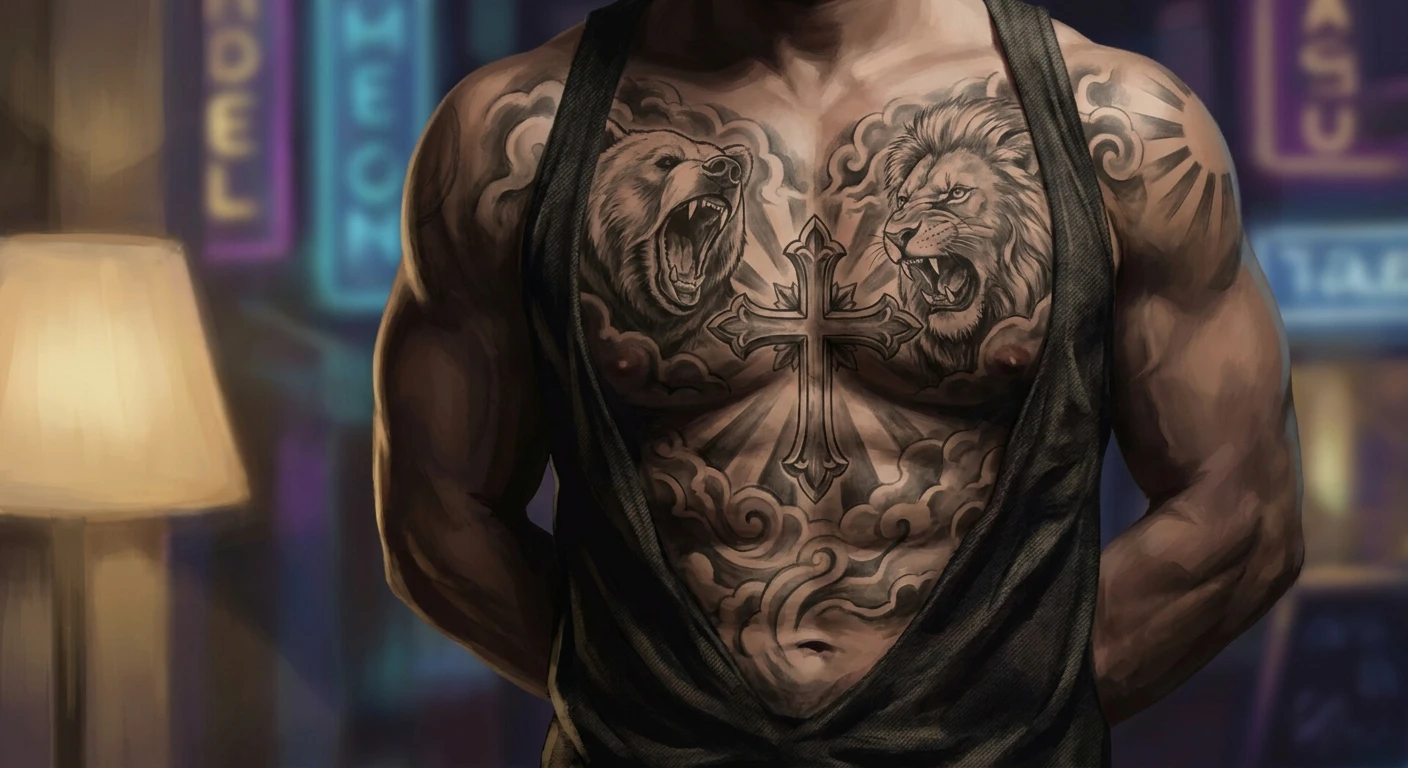
| The Giant Cross | Center Chest | A massive, bold declaration of his Christian faith and spiritual grounding. |
| The Roaring Bear | Right Pectoral | Symbolizes rest, strength, and the raw, aggressive side of his personality. |
If you genuinely want to understand his layout, you have to recognize the three defining characteristics of his ink style. These elements are what make his canvas look entirely cohesive instead of just feeling like a bunch of random stickers:
- Heavy Religious Iconography: He heavily leans into his faith. From the massive cross on his chest to the hyper-realistic angels defeating demons on his stomach, spiritual warfare is his primary aesthetic theme.
- Wildlife and Animal Symbolism: He uses apex predators to represent different facets of his emotional state. The lion represents royalty and courage, while the bald eagle represents freedom and soaring above the intense media scrutiny he faces daily.
- Tribute and Milestone Pieces: From the intricate roman numerals on his chest indicating his mother’s birth year, to the word ‘Purpose’ marking his massive musical comeback, he uses typography to timestamp major life events.
When you put all these elements together, you get a masterpiece of black and grey wash style.
The Origins of His Ink
The entire journey started completely under the radar. Back in 2010, when he was just a teenage pop sensation singing ‘Baby,’ he quietly got a tiny outline of a seagull on his left hip. This was not a spur-of-the-moment teenage rebellion. It was a deeply rooted family tradition. Several male members of his family have the exact same bird, inspired by the classic novella ‘Jonathan Livingston Seagull.’ It was a promise to always fly higher and break away from the flock. For a while, he kept this completely hidden. It was his little secret, a grounding mechanism during a time when the entire world was trying to control his image and turn him into a manufactured teen idol.
The Evolution Through the Teenage Years
As the pressure of fame skyrocketed, so did his time in the tattoo chair. His left arm slowly transformed into a full sleeve, piece by piece. This was an era of intense emotional turbulence. We saw the addition of the infamous angel on his wrist—widely known to be a portrait resembling his ex-girlfriend Selena Gomez. He added a tiger, an owl signifying wisdom, and the eye of his mother, Pattie Mallette, resting directly on the inside of his elbow. During these years, his ink was somewhat chaotic. It was collected randomly from various shops around the world while he was on tour, perfectly reflecting the frantic, unpredictable nature of his late teens and early twenties.
The Modern State of His Canvas
Fast forward a few years, and he finally decided to pull it all together. He hired the legendary celebrity tattoo artist Keith “Bang Bang” McCurdy to unify the chaotic front of his torso. Over the course of three brutal days, Bang Bang added gothic arches, gargoyles, skeletons, and clouds to seamlessly connect the bear, the lion, and the massive cross. The result is a unified, armor-like piece of body art that covers his entire chest and stomach. Even in 2026, his stomach piece remains one of the most iconic pop-culture tattoos in existence. He no longer looks like a kid collecting stickers; he looks like a man wearing his life experiences as a permanent shield.
The Science of Tattoo Saturation
Have you ever wondered how someone sits for over a hundred hours of tattooing without their skin completely rejecting the process? The science behind black and grey wash tattoos is genuinely mind-blowing. When the tattoo machine operates, it drives tiny groupings of needles into the skin between 50 and 3,000 times a minute. The goal is to bypass the epidermis—the outer layer of skin that constantly sheds—and deposit the ink directly into the dermis.
Once the ink is inside the dermis, your body’s immune system immediately registers it as an invading foreign substance. White blood cells, specifically macrophages, rush to the site to “eat” the ink particles. However, the ink molecules are far too large for the macrophages to carry away. The cells simply die, holding onto the ink, and remaining trapped in the dermis forever. That biological battle is literally what keeps the art visible on the skin.
Pain Mapping on the Human Body
Getting your arms tattooed is generally a breeze, which is why his sleeves came first. But the massive torso pieces he endured? That requires an entirely different level of pain tolerance. The sternum, the ribcage, and the lower abdomen are incredibly dense with nerve endings and sit directly over bone.
- Epidermal Trauma: The constant wiping and needle dragging strips away the protective barrier, leaving the skin highly vulnerable to swelling.
- Nerve Density: Areas like the sternum lack fat and muscle, meaning the vibration of the tattoo machine rattles the actual bone.
- Adrenaline Fatigue: After about three hours in the chair, the human body completely stops producing adrenaline, causing the pain to spike exponentially. He sat for over 26 hours in just three days for his torso piece, battling severe adrenaline crashes.
Step 1: Map Out Your Story
If you want to build a sleeve or a torso piece that captures this exact vibe, you need a plan. Do not just walk into a random parlor. First, identify your core themes. Are you focusing on spirituality, family, or personal growth? Write down three major concepts that define your current mindset.
Step 2: Choose Your Anchor Piece
Every great layout needs an anchor. For him, it was the massive cross on his chest. You need one large, central design that dictates the flow of everything else. It could be a large animal portrait on your outer bicep or a central chest emblem. Go big with this one.
Step 3: Find a Black and Grey Specialist
Do not go to a traditional American or color-realism artist. You need someone who specializes in black and grey wash, fine lines, and micro-realism. Check portfolios strictly for smooth shading and stark, bold contrast.
Step 4: Book the Outline Session
Rome was not built in a day, and neither is a cohesive torso piece. Your first major session should be dedicated strictly to outlining the major shapes. This establishes the structural framework and allows you to see how the shapes flow with your natural muscle anatomy.
Step 5: Add Shading and Contrast
The magic happens during the shading phase. This is where your artist dilutes black ink with distilled water to create varying tones of grey. This technique gives the tattoos that soft, almost photographic quality that his animal pieces are famous for.
Step 6: Integrate Micro-Portraits
To really emulate his style, you need small, hyper-detailed micro-pieces scattered around the major anchors. Think about adding a small, realistic eye, a tiny crown, or intricate roman numerals. These small details give the eye something to discover when looking closely.
Step 7: Connect with Filler Elements
The final step is the hardest. You have to tie it all together. Use gothic architecture elements, dark clouds, sunbeams, or subtle geometric patterns to fill the negative space. This transforms the individual tattoos into one massive, unified piece of clothing.
Myth: He severely regrets all his early tattoos and wishes he could laser them off.
Reality: He has openly stated on multiple occasions that he loves his body art and wouldn’t erase his past. He views his early pieces as necessary steps in his personal growth.
Myth: The massive stomach tattoo took only one single day to complete.
Reality: It took three consecutive days of grueling, non-stop work by his artist, requiring massive physical endurance.
Myth: The infamous angel on his wrist is completely covered up and gone forever.
Reality: He tried to heavily shade the face to obscure the features, but the clear silhouette and original outline of the angel remain completely visible to this day.
How many tattoos does Justin Bieber have?
He currently has well over 60 distinct tattoos, though many have been connected to form larger, unified pieces.
What was his first tattoo?
His very first piece was the tiny outline of a Jonathan Livingston Seagull on his left hip, done when he was just sixteen.
Who is his main tattoo artist?
While he has been tattooed by many artists globally, Keith “Bang Bang” McCurdy is responsible for unifying his torso and doing his most famous recent pieces.
Does he have tattoos on his face?
Yes, he has a tiny, extremely subtle cross resting right near the corner of his eye, representing his faith.
What does the bear tattoo mean?
The bear, positioned on his chest, is a traditional symbol of immense strength, rest, and fierce protection of his loved ones.
Is his neck tattoo finished?
He has several pieces on his neck, including a long stem rose and the word ‘Patience,’ which currently cover most of the available space.
Does he have a tattoo for his mom?
Absolutely. He has her birth year stamped in roman numerals on his chest, and an incredibly detailed, hyper-realistic drawing of her eye in the crease of his elbow.
There you have it—the absolute, unfiltered breakdown of his living canvas. His ink is way more than just a pop-culture trend; it is a meticulously crafted visual diary of an incredibly complex life. If you loved this deep dive and want more raw, honest breakdowns, drop a comment down below and tell me which celebrity canvas I should map out next!

Leave a Reply